Introduction
Web development has become an essential part of modern business, helping companies establish their online presence, connect with customers, and streamline daily operations. From professional business websites to advanced web applications, the right digital solution can improve customer engagement, strengthen brand credibility, and support business growth.
At Scideas Solutions Pvt. Ltd., we provide web development solutions tailored to business requirements. By combining modern technologies, responsive design, and practical functionality, businesses can build digital platforms that meet current needs and adapt to future opportunities.
What Is Web Development?
Web development is the process of designing, building, testing, and maintaining websites and web applications. It includes everything from creating the visual interface customers interact with to managing databases, application logic, and server operations behind the scenes.
Web development is generally divided into three major areas:
- Frontend Development: Focuses on the visible elements of a website, including layouts, navigation, buttons, forms, and interactive features.
- Backend Development: Manages server-side functionality, databases, authentication, business logic, and application security.
- Full-Stack Development: Combines frontend and backend development to create complete web solutions.
Understanding these areas helps businesses select the right development approach for their projects.
Essential Technologies Used in Web Development
Modern websites rely on a combination of programming languages, frameworks, and development tools. Selecting the right technology stack depends on project complexity, performance requirements, budget, and long-term maintenance.
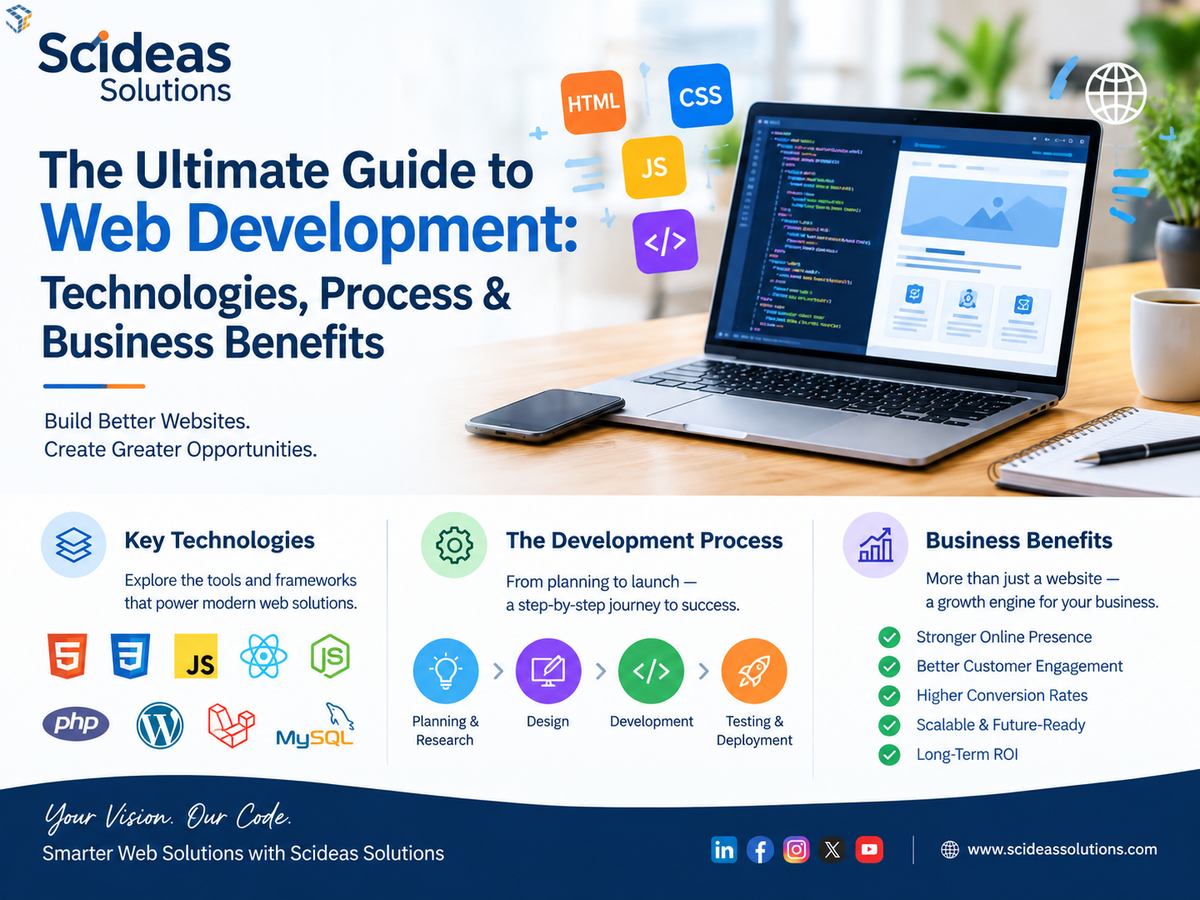
1. HTML, CSS, and JavaScript
HTML provides a webpage’s structure, CSS controls its appearance, and JavaScript adds interactivity. Together, these technologies form the foundation of frontend development.
They help developers create responsive layouts, interactive menus, dynamic forms, and engaging user interfaces that work across different devices.
2. React.js and Next.js
React.js helps developers build interactive interfaces using reusable components. Next.js extends the React ecosystem with capabilities that can support server rendering, routing, and performance optimization.
These technologies are useful for businesses that require modern websites, customer portals, dashboards, and scalable web applications.
3. PHP and Laravel
PHP remains a practical choice for developing dynamic websites and web applications. Laravel provides a structured development framework with tools for routing, authentication, database operations, and application maintenance.
Businesses can use Laravel to build custom portals, management systems, business applications, and platforms that require specific workflows.
4. WordPress, Drupal, and Magento
Content management systems help businesses manage website content efficiently. WordPress is widely used for business websites and blogs, while Drupal supports structured content requirements and complex digital platforms. Magento is designed for e-commerce businesses that need online product catalogues and shopping functionality.
Choosing the right platform aligns website capabilities with operational goals.
Why Web Development Matters for Businesses
A professionally developed website can serve as a central point for marketing, customer communication, and online service delivery.
Improved brand credibility: A well-structured website helps communicate a company’s services, expertise, and value proposition.
Better customer experience: Clear navigation, responsive layouts, and useful content make it easier for visitors to find information.
Lead generation: Contact forms, enquiry pages, service descriptions, and calls to action can encourage potential customers to connect with a business.
Operational efficiency: Custom web applications can simplify repetitive tasks, centralize information, and connect different business systems.
Business scalability: Flexible architecture makes it easier to introduce new features as customer expectations and business requirements evolve.
The Web Development Process
Successful web development requires a structured approach that connects business objectives with technical implementation.
Step 1: Planning and Requirement Analysis
The process begins by identifying the target audience, project objectives, essential features, budget, and expected outcomes. Clear requirements help establish priorities and reduce unnecessary changes later.
Step 2: UI/UX Design
Designers plan the website’s structure, navigation, visual elements, and user journeys. Wireframes and prototypes help stakeholders review the proposed experience before development begins.
Step 3: Development
Frontend developers create the interface, while backend developers implement server-side functionality, databases, and integrations. Full-stack development can bring both areas together through a coordinated approach.
Step 4: Testing and Quality Assurance
Testing checks whether website features work correctly across browsers and devices. Functional, integration, usability, and performance testing help identify issues before launch.
Step 5: Deployment and Maintenance
Once approved, the website is deployed to its hosting environment. Ongoing maintenance includes security updates, backups, performance monitoring, bug fixes, and improvements as business needs change.
Important Considerations for Modern Websites
Businesses should look beyond appearance when investing in web development. Several technical factors influence a website’s long-term effectiveness.
- Responsive design: Ensure the website adapts to desktop, tablet, and mobile screens.
- Performance optimization: Improve loading speed through efficient code, optimized images, and appropriate caching.
- Security: Apply secure authentication, access controls, regular updates, and suitable data protection measures.
- SEO-friendly structure: Use logical navigation, descriptive page titles, clear headings, and crawlable content.
- Third-party integrations: Connect relevant CRM, payment, marketing, and business management systems where required.
- Scalability: Choose technologies and architecture that support future improvements without unnecessary complexity.
Addressing these considerations from the beginning helps create a more reliable and maintainable digital platform.
Web Development Services at Scideas Solutions
At Scideas Solutions Pvt. Ltd., we understand that every business has different requirements. Some need a professional company website, while others need a custom web application, an e-commerce platform, or integrations that connect existing business tools.
Our web development expertise includes PHP, Laravel, React.js, Next.js, Node.js, WordPress, Drupal, and Magento. We work on digital solutions with a focus on usability, performance, functionality, and future maintenance.
Whether you are planning a new website or looking to improve an existing platform, understanding your business requirements is the first step towards choosing the right solution.
Conclusion
Web development will continue to evolve as businesses look for better ways to serve customers, simplify operations, and strengthen their online presence. AI-powered features, mobile-friendly design, faster websites, secure development, and connected business systems will remain important considerations.
Still, a website’s success does not depend on technology alone. It depends on how well the solution addresses a real business need and how easily people can use it.
At Scideas Solutions, we believe that effective web development begins with listening to the client, understanding the challenge, and building a solution around the requirements.
Planning a new website or web application? Visit Scideas Solutions to explore our services and discuss your web development requirements.