Customer expectations are changing faster than ever. People want quick responses, personalized experiences, seamless communication, and consistent service across every channel. At the same time, businesses need better visibility into customer interactions, sales activities, marketing performance, and support operations.
This is where modern Customer Relationship Management (CRM) platforms are becoming increasingly important.
In 2026, CRM is no longer simply a system for storing customer details or tracking sales opportunities. It is becoming a connected business environment where AI, automation, customer data, analytics, integrations, and human expertise work together.
From Salesforce and SugarCRM to SuiteCRM and customized CRM solutions, businesses are looking for technologies that can improve productivity while creating stronger customer relationships.
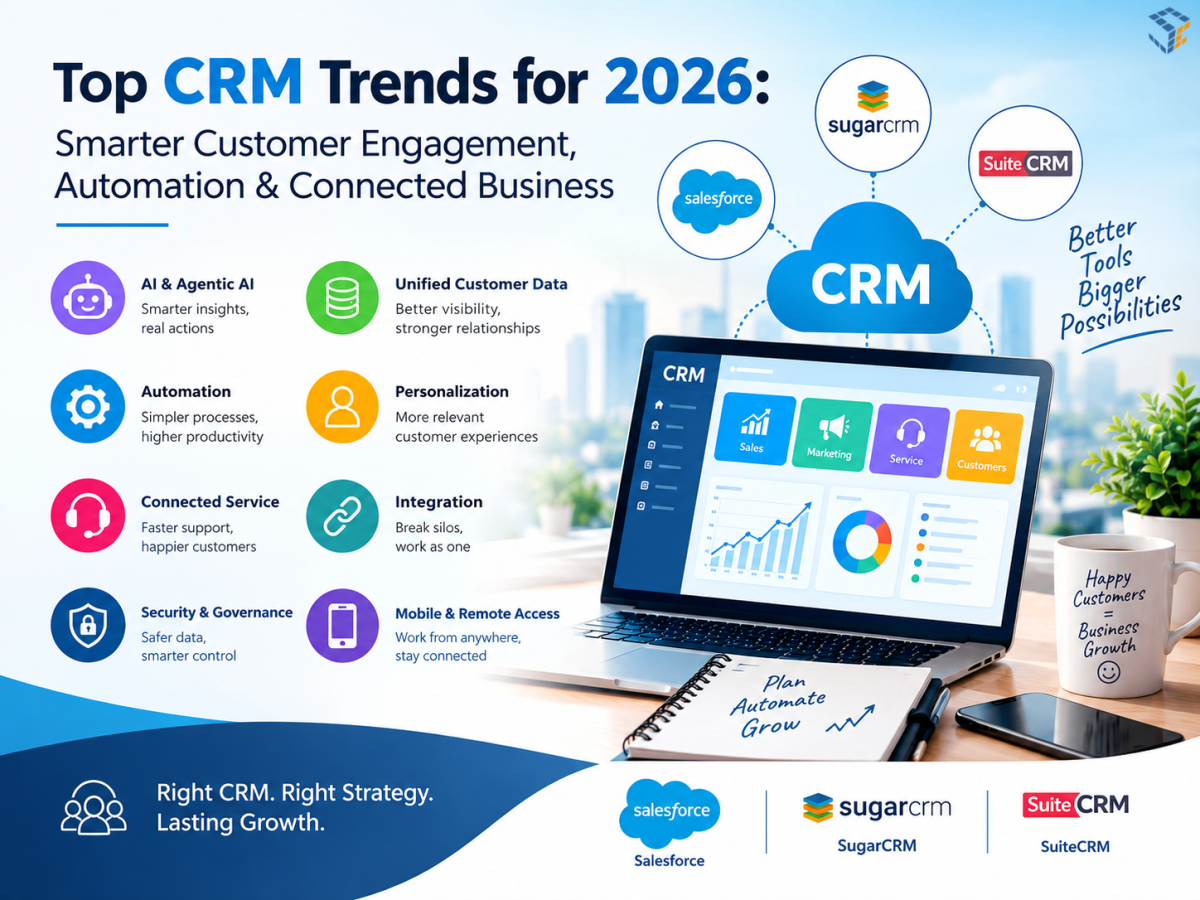
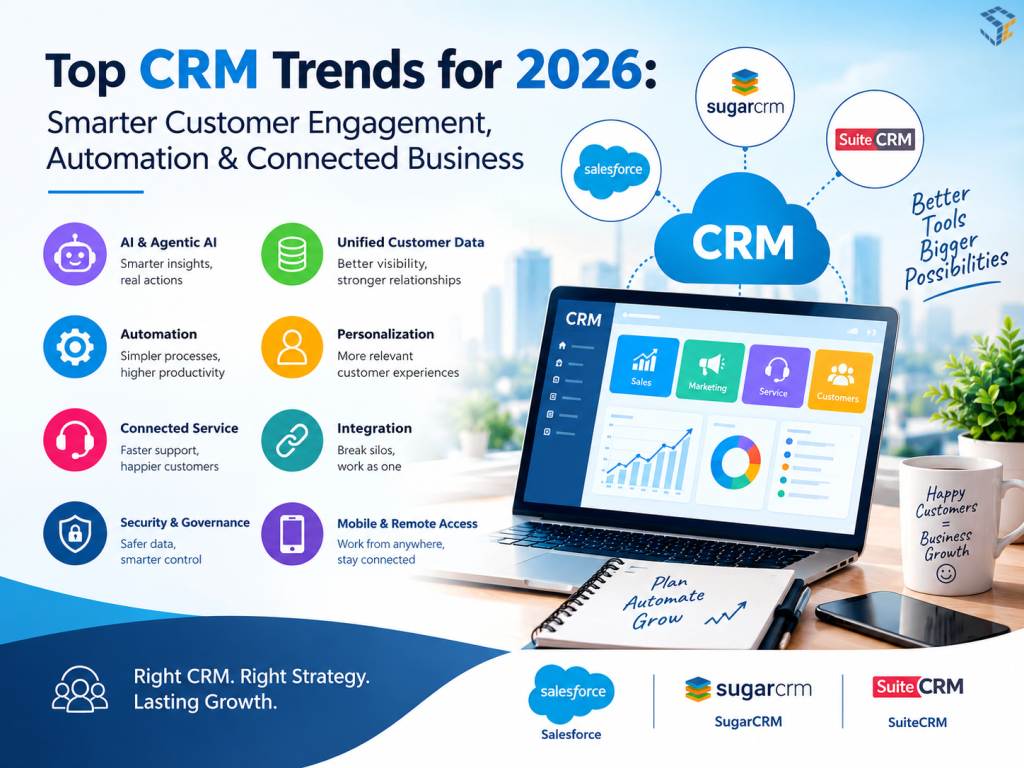
Here are the major CRM trends shaping 2026 and what they mean for businesses.
1. AI Is Becoming a Core Part of CRM
Artificial intelligence is one of the biggest changes happening in CRM.
Earlier, CRM users mainly depended on dashboards, reports, workflows, and manually entered information. Today, intelligent CRM capabilities can help teams understand customer behavior, identify opportunities, summarize interactions, recommend next actions, and automate repetitive activities.
The next stage is agentic AI, where AI-powered systems can go beyond providing suggestions and assist with completing business tasks.
For sales teams, this could mean faster lead qualification and follow-ups. For customer service teams, AI can help summarize cases, find relevant information, and support agents during customer interactions.
The real value of AI in CRM, however, depends on the quality of business data and how effectively it is integrated into existing processes.
2. Customer Data Is Becoming More Valuable
A business may have customer information in its CRM, website, email platform, ERP, marketing system, support application, and other third-party tools.
When these systems operate separately, employees may not have a complete understanding of the customer.
In 2026, businesses are focusing more on connected and reliable customer data.
A modern CRM strategy should help organizations bring relevant information together so sales, marketing, and support teams can work with a more complete customer view.
This is why CRM integration, data synchronization, data quality, and governance are becoming major priorities.
3. CRM Automation Is Moving to the Next Level
Automation is not a new CRM concept, but its role is expanding significantly.
Businesses are now looking beyond simple email notifications and task assignments. They want to automate complete business processes.
For example:
Lead Generated → Lead Qualified → Sales Follow-Up → Opportunity Created → Proposal Sent → Deal Closed → Customer Onboarded → Support
When these activities are connected through CRM automation, teams can reduce repetitive administrative work and improve process consistency.
Salesforce Flow, workflow automation, APIs, integration platforms, and customized CRM processes can all contribute to a more efficient operating model.
4. Personalization Will Drive Better Customer Experiences
Customers do not want generic communication.
They expect companies to understand their interests, previous interactions, requirements, and preferences.
Modern CRM platforms allow businesses to use customer information to create more relevant experiences across sales, marketing, and support.
For example, a sales team can understand a customer’s previous interactions before making a call, while a service representative can see relevant customer history before responding to a support request.
The result is a more informed and personalized customer journey.
5. CRM and Customer Service Are Becoming More Connected
CRM is increasingly becoming the central point for customer service operations.
Businesses can connect customer records with support cases, communication history, knowledge resources, chat, automation, and service workflows.
AI-powered assistants and conversational tools can also help customers get faster answers to common questions.
However, automation should not eliminate human interaction completely.
The strongest customer service strategies will combine AI-driven speed with human judgment and empathy when customers need more personalized assistance.
6. Integration Will Be a Major CRM Requirement
No CRM system works in isolation.
Businesses commonly use multiple applications for accounting, ERP, marketing, payments, communication, analytics, e-commerce, and internal operations.
A CRM platform must therefore be able to communicate with these systems.
In 2026, organizations will increasingly invest in:
- REST and SOAP API integrations
- Third-party application integration
- ERP and CRM connectivity
- Marketing automation integration
- Payment gateway integration
- Data synchronization
- Secure authentication
- Custom middleware solutions
For Salesforce users, technologies such as Apex, LWC, Platform Events, Flow, REST/SOAP APIs, OAuth, and Named Credentials can play an important role in building connected solutions.
7. Salesforce, SugarCRM and SuiteCRM Will Continue to Support Different Business Needs
Not every business needs the same CRM platform.
Salesforce is a strong choice for organizations looking for a highly scalable CRM ecosystem with extensive customization, automation, integrations, and cloud capabilities.
SugarCRM can be suitable for businesses looking for flexible CRM functionality across sales, marketing, and customer service.
SuiteCRM provides an open-source CRM approach that can be attractive to organizations looking for greater control over customization and deployment.
The right CRM depends on business size, processes, budget, integrations, customization requirements, and long-term goals.
That is why CRM selection should begin with business requirements rather than simply choosing the most popular platform.
8. CRM Security and Data Governance Are Becoming Critical
As CRM systems handle more customer information and become connected with AI and external applications, security cannot be overlooked.
Businesses need to consider:
- User access and permissions
- Data privacy
- Authentication
- API security
- Data visibility
- Integration security
- Backup and recovery
- AI governance
A CRM strategy should therefore include security and governance from the beginning of the implementation.
9. Mobile and Remote CRM Access Will Remain Important
Modern teams are not always working from a single office.
Sales representatives, managers, service professionals, and remote teams need access to important customer information wherever they work.
Mobile-friendly CRM applications and cloud-based platforms allow employees to review customer records, update opportunities, manage tasks, and respond to customers without depending on a traditional office environment.
This flexibility can improve productivity while helping teams respond faster.
10. CRM Will Become More Business-Specific
A major trend in 2026 is the move away from a one-size-fits-all CRM approach.
Different industries have different processes.
A healthcare organization may need patient-related workflows and secure data management. A real estate business may need property and lead management. Educational institutions may require admissions, student communication, and engagement workflows. Financial businesses may require specialized customer and compliance processes.
As a result, CRM customization and industry-specific solutions will continue to grow.
Businesses want CRM platforms that fit their processes rather than forcing employees to completely change the way they work.
How Scideas Solutions Helps Businesses Build Better CRM Solutions
At Scideas Solutions, we understand that implementing a CRM is not simply about installing software. The real objective is to create a system that supports business processes, improves customer visibility, connects applications, and helps teams work more efficiently.
Our CRM expertise covers Salesforce, SugarCRM, and SuiteCRM, along with CRM development, customization, integration, migration, automation, and ongoing support.
For Salesforce projects, our expertise can support areas such as Apex, Lightning Web Components (LWC), Salesforce Flow, Experience Cloud, API integrations, automation, and customized CRM development.
For organizations using SugarCRM or SuiteCRM, we can help with implementation, customization, integration, migration, enhancement, and support based on specific business requirements.
You can explore our CRM services:
Salesforce Development: https://scideassolutions.com/services-offered/crm/sales-force/
SugarCRM Services: https://scideassolutions.com/services-offered/crm/sugarcrm/
SuiteCRM Services: https://scideassolutions.com/services-offered/crm/suitecrm/
Our approach is focused on understanding the business first and then selecting the right technology, architecture, integrations, and customization strategy.
The Future of CRM in 2026
The CRM industry is moving from record-keeping to intelligent business engagement.
AI is making CRM more proactive. Automation is reducing repetitive work. Connected data is improving customer visibility. Integrations are bringing business applications together. Personalization is helping organizations build stronger customer relationships.
But technology alone does not guarantee CRM success.
Businesses need the right combination of strategy, people, processes, data, technology, security, and continuous improvement.
In 2026, the most successful CRM strategies will be those that do more than manage customer information. They will help businesses understand customers better, respond faster, automate intelligently, and build long-term relationships.
With the right CRM partner and implementation approach, platforms such as Salesforce, SugarCRM, and SuiteCRM can become powerful foundations for digital transformation and sustainable business growth.