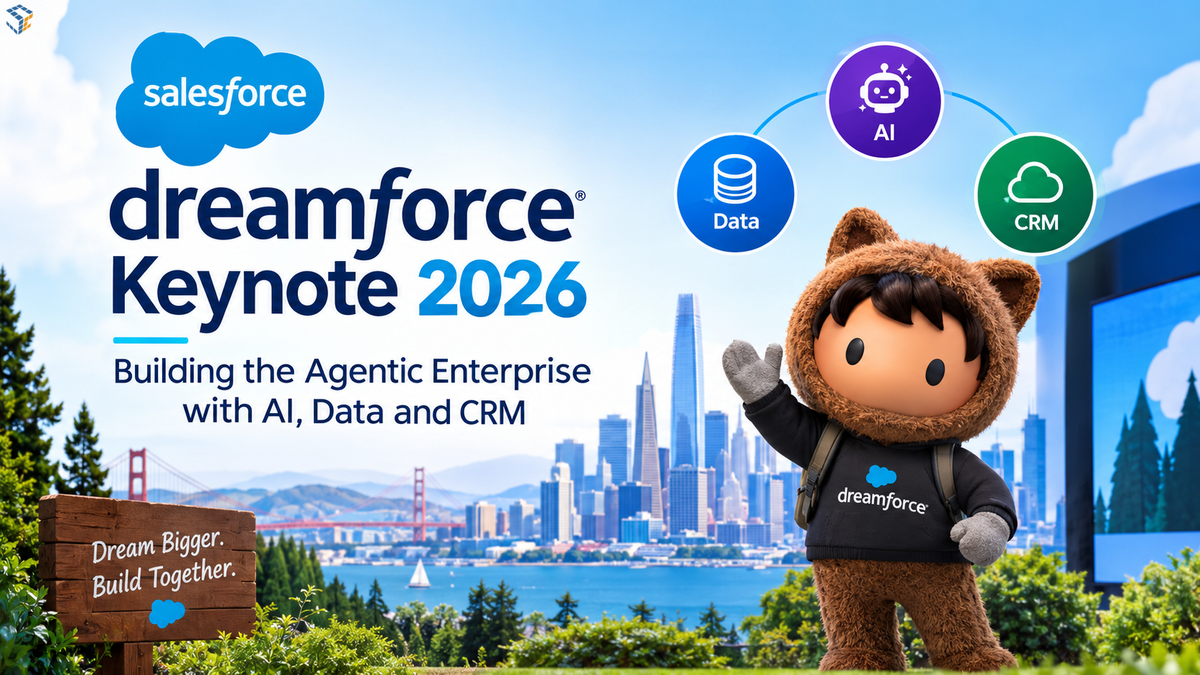
Salesforce Dreamforce 2026 once again brought together business leaders, CRM professionals, developers, administrators, architects, and technology experts to discuss how enterprise technology is changing. Held in San Francisco from September 15–17, the event placed the Agentic Enterprise at the heart of Salesforce’s vision for the future of business technology.
During the Main Keynote on September 15, Salesforce Chair and CEO Marc Benioff, along with special guests, explored how people, AI agents, applications, workflows, and trusted business data can work together. The focus was not simply on adding AI to existing software. Instead, Salesforce presented a broader approach in which AI becomes part of everyday business operations, while people continue to guide important decisions and customer relationships.
Understanding the Agentic Enterprise
The idea of the Agentic Enterprise was one of the strongest themes throughout Dreamforce 2026. Traditionally, enterprise software has depended on people opening applications, finding information, completing forms, and manually moving processes forward. The agentic approach introduces AI agents that can assist with tasks, understand business context, and work with defined processes.
This does not mean replacing every human activity. Instead, the model focuses on collaboration between people and intelligent systems. Employees can remain responsible for strategy, judgment, approvals, and relationships, while agents can assist with information retrieval, repetitive work, workflow execution, and other defined activities.
For CRM environments, this creates an opportunity to connect AI with customer records, business logic, automation, APIs, permissions, and existing workflows rather than treating AI as an isolated feature.
AIforce: Bringing Salesforce Capabilities to Where Work Happens
One of the major announcements at Dreamforce 2026 was AIforce. Salesforce describes it as a live interface layer designed to bring Salesforce data, workflows, business logic, permissions, security, and governance into the interfaces where people and agents work.
This is an important development for organizations that use several business applications. Employees often move between CRM platforms, communication tools, databases, analytics systems, and other applications throughout the day. Connecting business information and workflows across these environments can reduce unnecessary switching and provide users with more relevant context.
For developers and technology teams, AIforce also highlights the growing importance of composable interfaces, APIs, integrations, and reusable business services.
Agentforce and Intelligent Automation
Agentforce continues to be a major part of Salesforce’s AI strategy. At Dreamforce 2026, Salesforce highlighted expanded AI-agent capabilities designed to support work across areas such as sales, service, commerce, and employee productivity.
The practical applications can include helping service teams respond to customers, supporting sales activities, retrieving information, updating records, and coordinating defined workflows.
However, implementing AI agents successfully requires more than simply enabling a new feature. Organizations need clearly defined processes, reliable data, suitable permissions, human escalation paths, monitoring, and governance. The quality of the business process remains an important part of the overall result.
Data 360 and the Importance of Trusted Data
AI is only as useful as the information available to it. This makes Data 360 an important part of Salesforce’s broader Agentic Enterprise strategy.
Businesses commonly maintain customer and operational information across CRM systems, websites, marketing platforms, support applications, databases, and external services. Bringing these sources together can help organizations develop a more complete understanding of customers and business activity.
Dreamforce 2026 also highlighted data quality, identity resolution, governance, and trusted context as important foundations for AI. Salesforce’s session catalog included dedicated content on eliminating duplicate data, creating unified customer views, and preparing trusted context for Agentforce.
For organizations adopting AI, this means that data management cannot be treated as a secondary technical task. Clean, accessible, well-governed data is becoming a fundamental requirement for intelligent automation.
Trust, Security and Governance
As AI agents gain access to enterprise information and workflows, security becomes increasingly important. Businesses need clear answers to questions such as: What data can an agent access? Which actions can it perform? When should a human approve an action? How should activities be monitored?
Salesforce placed significant attention on trust across agents, data, and platforms during Dreamforce 2026. The event also featured sessions covering Data 360 governance and secure approaches for powering the Agentic Enterprise.
For enterprises, responsible AI adoption therefore involves more than technology selection. Access controls, data governance, compliance requirements, permissions, auditability, and human oversight all need to be considered during implementation.
What Dreamforce 2026 Means for Salesforce Developers and Administrators
The shift toward agent-based CRM also changes the technical landscape for Salesforce professionals.
Developers and administrators are increasingly working with technologies such as Apex, Lightning Web Components, Flow, APIs, integrations, Data 360, automation, security, and AI agents. Understanding how these components interact is becoming increasingly important when designing modern Salesforce solutions.
A developer may no longer focus only on how an application performs a specific task. The architecture may also need to consider how an AI agent accesses the application, what information it can use, what actions it can perform, and how those actions fit within existing business rules.
Dreamforce 2026 included dedicated technical sessions for developers, architects, and administrators, reflecting this broader change in the Salesforce ecosystem.
How Scideas Solutions Can Support Salesforce Transformation
For businesses exploring these technologies, the transition toward an Agentic Enterprise can also create new opportunities for Salesforce development, customization, integration, and support.
Scideas Solutions works with businesses on CRM and web-based technology solutions, including Salesforce development, customization, integrations, automation, and ongoing technical support. As organizations explore AI-enabled CRM environments, a structured approach can help connect Salesforce capabilities with existing applications and business processes.
The focus should be on understanding the actual business requirement first and then selecting the right combination of CRM configuration, custom development, integration, automation, data architecture, and AI capabilities.
This approach can help businesses build technology solutions that are practical, maintainable, and aligned with their existing operations.
The Business Direction Ahead
Dreamforce 2026 reflects a wider change in enterprise software. CRM is moving beyond traditional customer records and sales tracking toward connected environments where data, applications, automation, analytics, AI agents, and people can work together.
For businesses, the opportunity is not simply to introduce AI because it is a new technology. The more useful approach is to identify specific processes where automation can reduce repetitive work, improve access to information, support employees, or create smoother customer experiences.
At the same time, businesses need to maintain strong data foundations and clear governance. Without reliable data and well-designed processes, advanced AI capabilities may not deliver the expected business value.
Conclusion
The Salesforce Dreamforce 2026 Keynote presented the Agentic Enterprise as a significant direction for the future of CRM and enterprise technology. With developments around AIforce, Agentforce, Data 360, automation, integrations, trusted data, and governance, Salesforce is expanding the role of CRM from a system for managing customer information into a broader platform for connected business operations.
For Salesforce developers, administrators, architects, and businesses, this evolution brings both new possibilities and new technical considerations. The future of CRM will increasingly involve the interaction of people, AI agents, trusted data, applications, workflows, APIs, and security controls.
As organizations begin exploring these capabilities, the most practical path is to combine innovation with strong fundamentals: understand the business problem, maintain quality data, design secure workflows, and introduce automation where it can provide clear value.
For companies such as Scideas Solutions, this evolving Salesforce landscape creates opportunities to help businesses connect CRM, custom development, integrations, automation, and emerging AI capabilities into solutions designed around real business needs.