
Problem Statement:
Organizations using Salesforce often face major challenges related to inaccurate, incomplete, inconsistent, or duplicate address data stored across Leads, Accounts, Contacts, Opportunities, Orders, and other business records.
Users frequently enter addresses manually, which leads to spelling mistakes, missing state or country values, inconsistent formatting, invalid postal information, and non-standardized address records.
These data quality issues create multiple business problems such as: –>
- ailed deliveries and shipment delays
- Incorrect customer information
- Poor CRM reporting accuracy
- Duplicate customer records
- Reduced automation reliability
- Increased operational costs
- Compliance and verification issues
- Poor customer experience
Standard Salesforce validation mechanisms are often not sufficient for validating global addresses or intelligently identifying similar state and country names entered in different formats.
For example: –>
- “USA”, “United States”, and “US” may represent the same country
- “California” and “Calif.” may refer to the same state
- Typographical errors like “Texs” instead of “Texas”
- Missing or partially entered address information
There was a need for an intelligent, scalable, and automated address validation solution inside Salesforce that could:
- Validate addresses in real-time
- Standardize state and country values
- Support global address searches
- Handle spelling variations and typos
- Improve CRM data quality
- Reduce manual validation efforts
- Integrate directly with Salesforce architecture
How the Package Works:
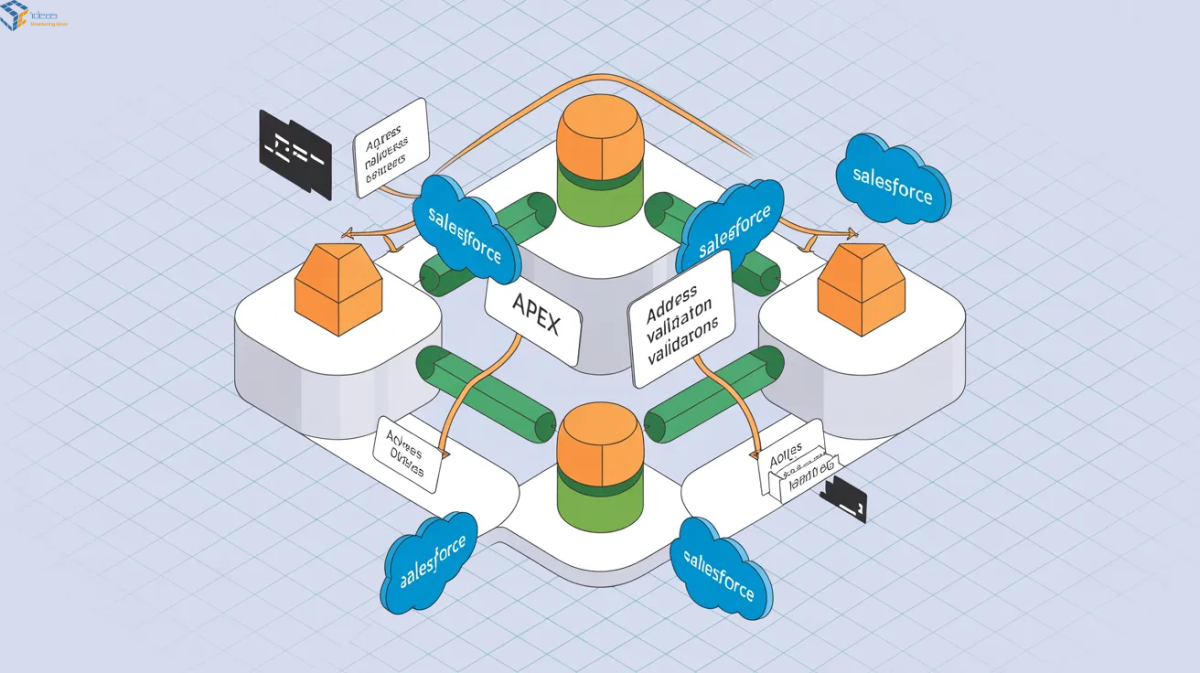
The package acts as an intelligent middleware layer between Salesforce and external address validation services.
Whenever address information is submitted, the package validates the data against external geographic databases and returns standardized results compatible with Salesforce State & Country Picklists.
The package supports both:
- Structured Address Search
- Unstructured Address Search
This allows the system to handle both properly formatted addresses and partially entered free-text addresses.
The fuzzy matching engine further improves validation accuracy by identifying the closest matching values even when users enter incomplete, abbreviated, or misspelled address information.
Objective of the Package:
The main objective of this package is to:
- Validate addresses entered by users
- Standardize Salesforce State and Country values
- Automatically populate Salesforce standard address fields
- Handle spelling mistakes and incomplete address information
- Improve CRM data quality
Conclusion
Accurate address information is critical for the smooth and efficient functioning of business processes in Salesforce. When State and Country/Territory Picklists are enabled, Salesforce validates entered values against predefined standards. Any incorrect or unsupported value can cause exceptions, preventing records from being created successfully.
To address this challenge, the solution acts as an intelligent middleware layer that validates and standardizes address data before it is stored in Salesforce. Custom address fields are used to capture the raw user’s input as a backup, ensuring that original data is never lost during the validation process.
The Address Search Package provides a scalable, reusable, and intelligent framework for address validation within Salesforce. Built using Apex callouts, Queueable Apex processing, fuzzy matching algorithms, and external address API integrations, the solution ensures that address data is standardized and compliant with Salesforce requirements.
The framework automates Lead address validation by allowing users to enter address details in custom fields while automatically populating Salesforce standard State and Country fields with validated and standardized values. This improves data quality, reduces manual effort, prevents record creation failures, and enhances the overall reliability of Salesforce business processes.